How Kruu Works?

Learning that unfolds over time
not in isolation

Kruu is designed to integrate into a student’s learning journey gradually. Rather than one-off workshops or compressed programs, our approach is built around sustained engagement, guided projects, and thoughtful reflection.

This outlines how that structure comes together in practice.

The Foundation Meaningful learning takes time. Students need space to explore questions, revisit ideas, and refine their thinking through feedback and iteration.

Everything at Kruu — from how projects are designed to how mentors engage — is shaped around this principle.

01. Choosing a question worth working on

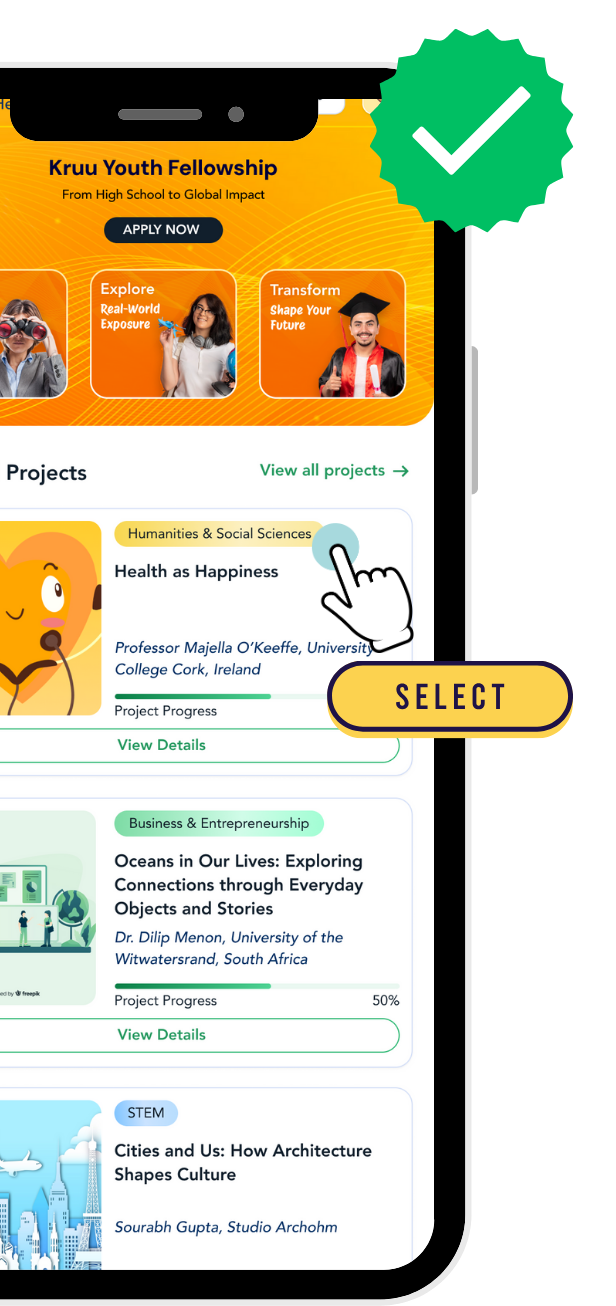
Every Kruu project begins with choice. Students select a problem or theme that genuinely interests them — across science, technology, humanities, policy, or creative fields.

This first step sets the direction for everything that follows. Students are introduced to the context of the topic, the kinds of questions professionals ask in that field, and why the problem matters beyond the classroom.

The goal at this stage isn’t to find answers. It’s to learn how good questions are formed.

MASTERCLASS

2. Learning from people who work on these problems

Once a project is chosen, students attend a masterclass led by a professor, researcher, or practitioner working directly in that field.

These sessions introduce students to how ideas are explored in real academic and professional settings — how research is framed, how constraints are navigated, and how complexity is handled.

Rather than delivering content to memorise, the masterclass provides a lens students will carry into their own work.

Research

3. Understanding before proposing

Students begin their project with structured research. Through guided worksheets, they gather information, study existing work, analyse data, and conduct basic primary research where relevant.


This phase helps students slow down and engage deeply with the subject — learning how evidence is collected, how assumptions are tested, and how insights emerge.

The focus is not speed, but clarity.
Ideate

4. Exploring possibilities, not rushing to solutions

With a research foundation in place, students move into analysis and ideation. They examine patterns, compare perspectives, and explore multiple ways the problem could be approached.

Students are encouraged to think broadly, test ideas, and refine their thinking — learning that meaningful solutions often evolve through iteration, not instant answers.

This stage builds judgement and confidence in independent thinking.

5. Turning ideas into something real

In the final phase, students design and build a solution. This could take the form of a research paper, prototype, policy brief, creative work, presentation, or digital artifact — depending on the project.

Students learn how ideas are communicated clearly and responsibly, and how work is shaped for real audiences.

What matters most is not polish, but thoughtfulness and intent.

website image banner (1)

Outcome · Reflection & Recognition

6. Reflecting on work and recognising depth

Completed projects are reviewed and acknowledged for the quality of thinking and effort involved. Students receive certification and, where applicable, access to further opportunities such as internships, showcases, or advanced programs.

More importantly, students finish with a clearer sense of how they learn, how they think, and what they want to explore next.

This is not the end of learning — it’s a reference point for what comes after.

01 06

Project Philosophy

How Kruu projects are
designed

Kruu projects are not simulations or short exercises. They are designed to mirror how work actually unfolds beyond classrooms — where problems are open-ended and answers are rarely immediate.

Projects are:

  • Guided, not scripted
  • Open-ended, but structured
  • Designed to unfold over time

The focus is on thinking clearly, not finishing quickly.

GUIDANCE

The role of
Mentors

Mentors at Kruu are practitioners and qualified graduate students who guide students through the learning process.

Their role is not to lecture or evaluate, but to ask better questions, provide context, and offer feedback as ideas develop. Mentorship is embedded into the project journey rather than added as a separate layer.

TANGIBLE OUTCOMES

What students
produce

  • Academic Portfolios
  • Applications & Essays
  • Future Learning Conversations

By the end of a learning cycle, students have work they can point to — project outputs, written reflections, and portfolios that reflect how they think and engage with ideas.

Who this works
best for

By the end of a learning cycle, students have work they can point to — project outputs, written reflections, and portfolios that reflect how they think and engage with ideas.

Taking the next steps

If this approach aligns with what you are looking for, the next step is to explore a program or speak to Kruu team about the fit.